A Practical Return to Strategy Classics
Strategy has long fascinated me as a craft worth mastering, so I’m returning to the classics to strip away noise, revisit timeless principles, and sharpen my strategic foundation.
I’ll use a simple framework throughout: read, reflect, apply. For each book, the aim is not to produce a summary, but to extract judgment: the strategic lens it offers, the hard question it raises, and the practical move it suggests.
In short: read to understand the author’s core model of strategy, reflect to reduce it to the few principles that are genuinely useful, including where they are powerful and where they may mislead and apply by using those principles against a real situation – professional or personal – to improve diagnosis, sharpen decisions, avoid weak moves, or strengthen positioning.
Below is the rough reading plan and what I’ll keep in mind as I work through each phase.
Phase 1 – Core Principles
Objective: Lock down timeless strategic fundamentals.
Read:
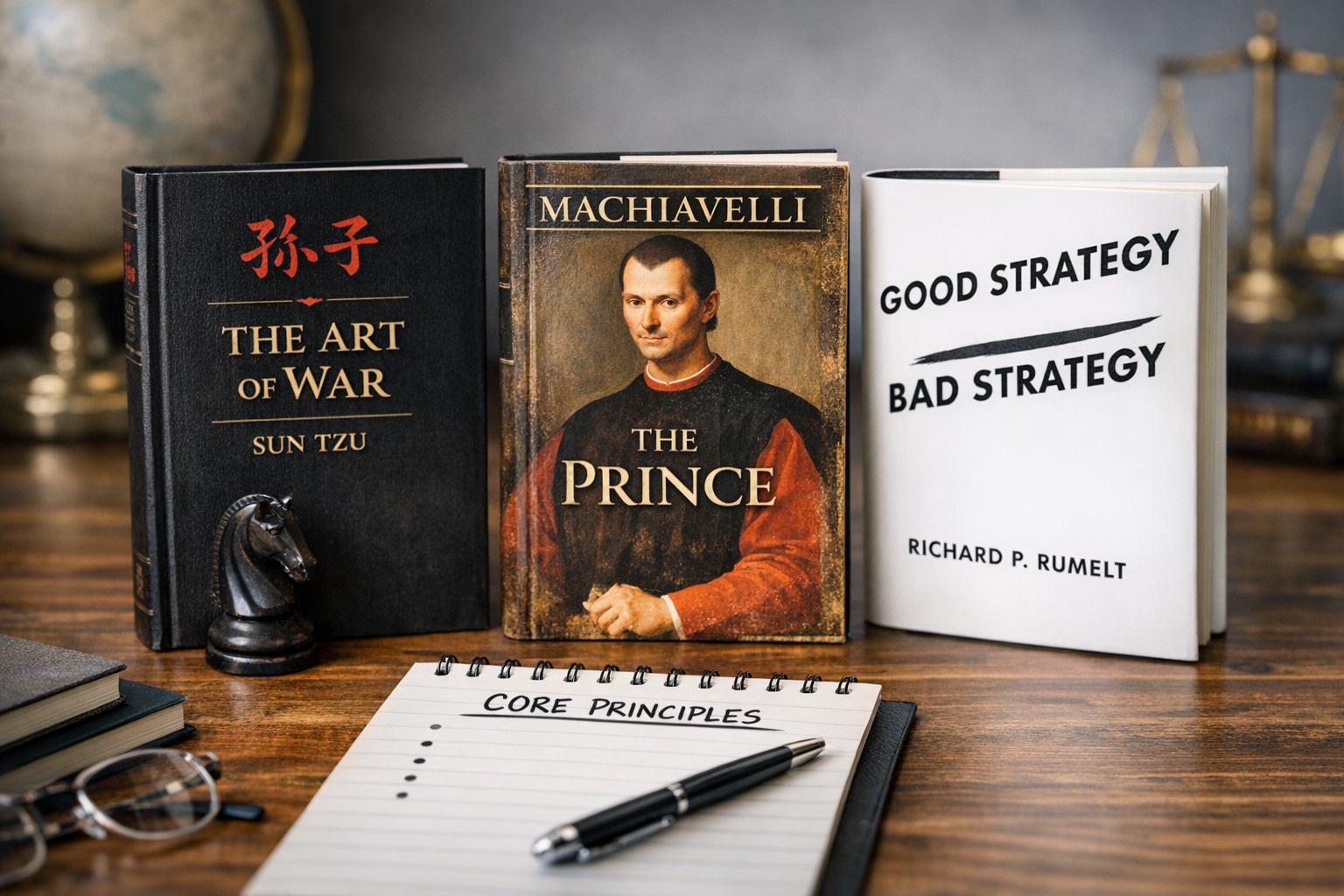
- The Art of War by Sun Tzu – indirect strategy, deception, and positioning.
- The Prince by Niccolò Machiavelli – realpolitik and pragmatic power.
- Good Strategy Bad Strategy by Richard Rumelt – diagnosis → guiding policy → coherent actions.
Reflect:
- For each book: What is the author’s view of advantage?
Apply:
- What current situation am I misdiagnosing, approaching too directly, or failing to turn into coherent action?
Phase 2 – Systems & Uncertainty
Objective: Build usable mental models for complex, dynamic environments.
Read:
- Thinking in Systems by Donella Meadows – stocks, flows, feedback, leverage points.
- On War by Carl von Clausewitz – friction, chance, and the fog of uncertainty.
- Superforecasting by Philip E. Tetlock – probabilistic decisions and calibration.
Reflect:
- What hidden feedback loop, delay, or uncertainty am I underestimating?
Apply:
- Make one better-calibrated decision by stating what I believe, how confident I am, and what evidence would change my mind.
Phase 3 – Power & Human Dynamics
Objective: Understand how power works in human systems and how to maneuver within them.
Read:
- The 48 Laws of Power by Robert Greene – tactics, traps, and leverage.
- The 33 Strategies of War by Robert Greene – tactical mental models.
- Poor Charlie’s Almanack (Charlie Munger) – multidisciplinary thinking and inversion.
Reflect:
- What does this reveal about incentives, influence, leverage, or human behavior?
Apply:
- Change one interaction, proposal, or positioning move to better account for power and incentives.
Phase 4 – Resilience & Future Vision
Objective: Build a resilient, long-range strategic lens.
Read:
- Antifragile by Nassim Nicholas Taleb – stress-driven growth, optionality, skin in the game.
- The Sovereign Individual by James Dale Davidson & William Rees-Mogg – macro-level strategic positioning.
- Zero to One by Peter Thiel – creation vs competition, vertical strategy.
Reflect:
- Where am I fragile, where do I have options, and where could I become better positioned?
Apply:
- Make one positioning move that improves downside protection, upside exposure, or long-term strategic independence.
If any of this sparks your curiosity, feel free to follow along – or even take on the reading yourself.
More from this reading project
– Martin